
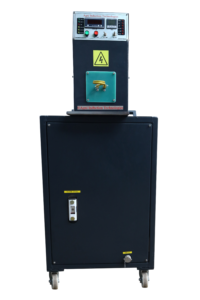
Induction Heating Machine Cooling System
In high-power induction heating, a cooling system is not just an accessory—it is a critical necessity. Because induction coils carry massive currents to generate magnetic fields, they produce significant internal heat (Joule heating). Without active cooling, these copper coils would melt or degrade, leading to system failure.
- Closed-Loop Water Cooling: The industry standard. Distilled or deionized water circulates through a sealed network of pipes and a heat exchanger. This prevents mineral buildup (scaling) and corrosion within the internal waterways.
- Open-Loop Water Systems: Uses water from a cooling tower or external source. While cost-effective initially, they often require more maintenance due to potential contamination and scaling.
- Air Cooling: Utilizes fans and heat sinks. Generally limited to low-power or portable units where the heat load is manageable without liquid media.
- Circulation Pump: Drives the coolant through the inductor and power supply at a specific pressure (typically at least 0.2 MPa).
- Heat Exchanger: Transfers heat from the hot coolant to the ambient air or a secondary water loop.
- Deionizer/Filter: Removes ions and particles from the water to maintain low conductivity, which is vital to prevent electrical arcing in high-voltage sections.
- Monitoring Sensors: Real-time tracking of flow rate, pressure, and temperature (inlet vs. outlet) to trigger safety alarms if cooling fails.