Scanners for scan hardening
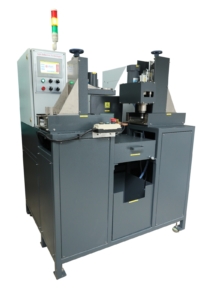
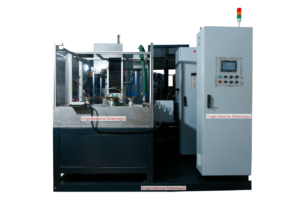
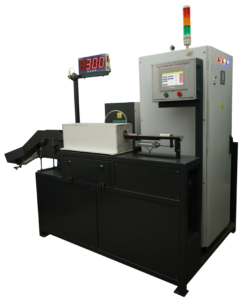
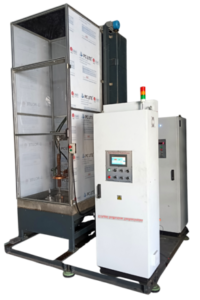
Automated induction heating scanners are crucial for precise, repeatable surface hardening of metal parts like shafts and gears. These systems leverage CNC or PLC controls to move the part relative to the induction coil, ensuring specific heating profiles and consistent quality.
An induction scanner works by progressively heating and quenching a part along its length. The process is highly controlled:
- Part Presentation: The metal workpiece (e.g., a shaft) is held vertically or horizontally, typically between centers, and rotated at a controlled speed.
- Scanning (Movement): The part moves past a stationary induction coil and quench ring, or vice versa, at a precise, user-defined feed rate. This creates the “scan.”
- Heating & Quenching: The induction coil rapidly heats a narrow band of the surface via eddy currents and hysteresis losses. Immediately following the coil is a quench ring that sprays the heated area with a specific cooling medium (water, polymer solution, or oil) to rapidly form a hard martensitic structure on the surface while leaving the core tough.
- Automated Control: The entire process is managed by a PLC or CNC system that monitors and adjusts power levels, frequency, scan speed, rotation speed, and quench flow in real-time, ensuring consistency.